As we enter 2026, numerous developments in emerging technologies, such as agentic AI, stablecoins, and digital assets, will drive key strategy issues and decision points for banks and credit unions looking to future-proof products and services for their customer base, as well as exploring new opportunities. Here are 10 key financial services technology developments and areas to watch this year.
1. Mobile/Account-to-Account
Mobile wallets are becoming more popular among consumers. Banks generally undervalue the influence of social media and video streaming platforms, which are influential in consumers' decisions. Cryptocurrency is also increasingly becoming a way for consumers to engage with mobile wallets. “With volumes of non-cash transactions expected to rise from 1,685 billion in 2024 to 3,540 billion by 2029, digital wallets and Account-to-Account (A2A) transfers are steadily replacing traditional card payments,” according to Capgemini's 2026 World Payments Report.
The shift is underscored by changes in how people shop, namely growth in e-commerce, mobile commerce and agentic commerce. “As digital becomes the default, both online and in-store transactions are increasingly dominated by wallets and instant payments, reshaping the payment mix and challenging legacy infrastructure,” Capgemini wrote. Banks and credit unions who are large issuers of traditional physical payment cards will need to expand strategies to include these new mobile, instant and digital asset payment methods to keep up with changing customer expectations.
2. Artificial Intelligence (AI)
Banks spent time in 2025 identifying potential use cases for artificial intelligence and developing policies to both guide its use within organizations and to meet legal and regulatory compliance obligations. But 2026 will see an increase in financial institutions having to address AI questions and issues both internally and externally as agentic AI increases in physical and digital commerce. And in the absence of federal regulation, state legislators have passed laws focused on transparency, discrimination and AI’s potential for consumer harm. On December 15, 2025, President Trump issued an executive order to curb state-level actions and work with Congress to pass a “minimally burdensome national standard” — one that would undoubtedly affect the banking sector. Meanwhile, states (California, Colorado, Florida, and Texas, to name a few) are still pursuing state-level AI laws and regulations.
How Will My Financial Institution Use AI?
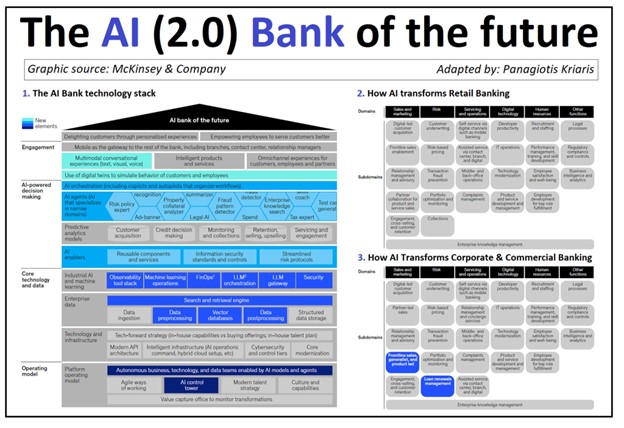
On the proactive side, financial institutions will need to determine what role AI will play in the organizations overall strategic planning and roadmap. The graphic at the end of this Client Alert shows what the AI Bank (2.0) of the future may look like, so how do financial institutions prepare for this journey?
- 4 Fundamentals Driving Internal Strategy: (1) reimagining the Customer experience (increased personalization, “frictionless” journeys, etc.); (2) using AI to augment human decision making; (3) modernizing bank/credit union core technology; and (4) setting up a “platform” operating model for the Bank’s products and services.
- Banks Using AI Well Tend to Focus on 4 Global Areas: (1) setting a bold, enterprise-wide vision for the value AI can create; (2) transforming entire domains, processes, and journeys vs. focusing on narrow AI use cases only; (3) building a full AI stack, increasingly powered by multiagent systems; and (4) sustaining and scaling value by setting up critical enablers of AI transformation.
- Orchestrating Multiagent Systems: Financial institutions are focused on using multiagent systems to create internal value by automating complex decisions and workflows using AI. Over time, financial institutions could have hundreds of AI agents at their disposal, each trained to complete a particular task and ready to be called on by other agents or humans. For example, in preparing credit memos, such multiagent systems could yield productivity gains of 20%-60%, and faster decision making by 30%. This could form the basis of more engaging experiences for customers and financial institution employees.
How will Agentic AI in Digital Commerce Affect My Financial Institution?
On the reactive side, financial institutions will need to understand how to address customer payments and transactions in an agentic AI world. “Agentic AI” in payments and transactions refers to AI systems that can take autonomous actions and make independent decisions to achieve specific user goals within a digital commerce environment (such as “find these Nike sneaker variants up to $250 in price, purchase them, and arrange for home delivery.”)
- Commerce and Payments are Becoming Increasingly AI-Driven: An increasing share of commerce and payment activity will be initiated by software agents outside of pilots, as shared protocols, governance models, and accountability frameworks compete for adoption across the value chain. AI-driven traffic to US retail websites increased 4,700% in 2025.[i] Tech and payments leaders are already betting on the shift to AI-driven digital commerce interfaces, and a growing wave of AI startups is also emerging, with a combination of the two developing the building blocks for fully autonomous shopping.[ii] Retail AI agents are moving beyond customer support to play a larger role in personalization and shopper engagement, including payment transaction authorization within certain parameters.
- Agentic Competition Escalation: As AI agents become widespread, incumbents and challengers will both increasingly compete for control, and enter into spheres of cooperation, regarding the agentic AI layer. Incumbents will embed agents into existing platforms, while challengers will position agents above multiple services to capture distribution. However, as of August 2025, almost half of the companies in the growing AI agent payments infrastructure market have partnered with or raised money from established payment leaders. Established payments players offer their customer trust, and startups developing solutions for AI payment rails bring agility and technical infrastructure that incumbents need.
Issuing financial institutions must also pay attention to the various standards emerging from payment networks (and any future standards). Each current approach below places different emphases on identity, intent, payment control, and standard setting:- Visa Trusted Agent Protocol (TAP): Visa is emphasizing identify verification by verifying the “who” behind the AI agent. Visa’s TAP is tied to Visa’s card network and seeks to cryptographically verify in real time that an AI agent making a purchase is indeed legitimate and truly acting on the purchaser’s behalf.[iii]
- Mastercard Agent Pay: Mastercard is emphasizing tokenization, restricting the “how” of the agentic AI transaction. Mastercard Agent Pay builds on Mastercard’s existing tokenization capabilities, creating “Mastercard Agentic Tokens.” Mastercard is also partnering with Microsoft Azure OpenAI Service and Copilot Studio to establish pathways for AI systems to complete purchases within conversational interfaces.[iv]
- Google Agent Payment Protocol (AP2): Google is emphasizing intent mandates by being able to cryptographically prove the “what” and “why.” AP2 is an open, payment agnostic standard for agents to transact via cards, bank transfers, or even stablecoins and cryptocurrency, using cryptographic user mandates to prove consent.[v]
- Stripe & OpenAI Agentic Commerce Protocol (ACP): Stripe and OpenAI are emphasizing standardized discovery and structuring the “where” to reduce friction and ambiguity by using standard setting and discoverability. ACP is an open-source solution focused on “conversational” checkout and seamless purchase, and utilizes shared payment tokens for AI-mediated transactions in chats/apps.[vi]
3. Fraud Shifts to Agentic AI/Agent Manipulation
Fraud will increasingly target agent-driven workflows rather than individual accounts or cards. Attackers will influence outcomes through input manipulation, synthetic interactions, and falsified context. Any issuing bank familiar with the current state of digital commerce knows the landscape of federal and state regulations and statutes, case law rulings, and payment network rules that set the framework under which a merchant must prove the purchaser’s intent and authorization to make a transaction.[vii]
Where agentic AI adds a wrinkle to the current framework is as follows:
- Current State: Under current checkout and payment flows, the human/company making the purchase is involved in both the Point of Intent (“I want to buy this”) and the Point of Checkout (“I authorize the purchase with my credit card”).
- Future State Under Agentic AI: Under agentic AI checkout and payment flows, the Point of Intent and the Point of Checkout are separated for the first time:
- The Point of Intent stays with the human who is delegating to the AI agent, and any related merchant terms and conditions probably need to stay with the human at the Point of Intent level as well to ensure enforceability. There should never be “autonomous code” acting solely as “buyer;” rather, the authorization point should be moved up the transaction chain to where the human authorizes the AI agent to take certain actions on the human’s behalf within a set of delegated parameters.
- The Point of Checkout is being delegated by the human to the AI agent under a set of parameters.
But the truly open question and unique issue for agentic AI transactions is who is liable when the AI agent itself malfunctions, such as hallucinating a transaction the human user did not authorize, or exceeding the boundaries of the authority delegated to it (e.g. buying 25 pairs of sneakers instead of 2 as instructed by the human user). The company developing the AI agent may try to disclaim all liability, along with direct and indirect damages in its terms of use. But if that is allowed, who gets stuck with the erroneous transaction loss “hot potato” – the user, the merchant, or the issuing bank for the payment method? Financial institutions, especially issuers, need to understand this emerging liability scenario with regard to any proposed agentic AI frameworks that the financial institution will have to work with to investigate alleged fraudulent or erroneous payment transactions.
4. Stablecoins and Tokenized Deposits
With the passage of the GENIUS Act and the push underway in Washington to formalize digital asset and crypto-related regulations, the “pegged to value” stablecoin and the emerging concept of “tokenized deposits” are seeing widescale interest, initial adoption and emerging use cases.
- Stablecoins as Settlement Infrastructure: Stablecoins are being envisioned as a new “settlement layer” of financial services to bypass cross-border transfer delays, cut-off times, trapped liquidity, and fee opacity in existing international payment rails. Stablecoins may ultimately sit underneath financial institutions and payment networks for specific B2B, treasury, and platform payout flows rather than replacing them altogether.
- Banks Tokenized Deposits Play: Tokenized deposits are generally digital representations of traditional bank deposits on a blockchain, representing a direct claim on fiat currency deposits held at the issuing financial institution, while offering enhanced efficiency, programmability and (ostensibly) security in financial transactions. Deposit “tokenization” may advance to where it improves core market infrastructure, with adoption concentrated in wholesale uses such as settlement, collateral management, and fund administration. Whereas stablecoins typically rely on a non-bank issuer and do not have FDIC insurance protection, tokenized deposits retain FDIC insurance protection while providing the flexibility to be transferred and settled “on chain.”
5. Tokenization Moves to the Infrastructure Layer
Tokenization may advance where it ultimately improves core market infrastructure, with adoption concentrated in wholesale uses such as settlement, collateral management, and fund administration.
6. Rise of AI-Native Fintechs
A new generation of fintechs is being built with AI embedded into core operations by default, allowing them to operate at lower marginal cost and handle higher volumes vs. legacy operating models. As these new fintechs launch and become potential vendors to, customers of or even partners of financial institutions, how to diligence, monitor and oversee such AI-native fintechs is an emerging challenge for financial institutions.
7. Fintechs Attempting to “Reclaim” The Banking Stack
The end of 2025 saw The Office of the Comptroller of the Currency (“OCC”) grant conditional national trust bank charters to major crypto and digital-asset firms—including Circle and Ripple, along with charter conversions for BitGo, Paxos and Fidelity Digital Assets.[viii] The Independent Community Bankers Association (“ICBA”) and other trade groups are pushing back on this development and warning that trust charters create regulatory arbitrage: national trust banks are not required to carry FDIC insurance, are exempt from the Community Reinvestment Act, and may avoid consolidated supervision—yet can still offer services that resemble core banking functions.[ix] More fintechs may seek to follow suit and pursue banking licenses to gain direct control over deposits, settlement, and economics, primarily to reduce dependence on sponsor banks and external balance sheets rather than to operate as full-service banks. This will be an area to pay close attention to in 2026.
8. Fintech Play Moving from Breadth to Depth
Fintech competition may also be shifting from broad coverage to execution within specific industries. Potential market advantages may come from developing novel methods to handle sector-specific cash flows, risk, and workflows, favoring embedded payments/finance vertical players over horizontal platforms. Certain fintechs may choose to become experts in areas such as construction logistics, healthcare receivables, or restaurant supply chains, not just in payments in general. Such niche-focused fintechs will seek to map industry-specific pain points to financial workflows and funds flow better than the current more generic incumbents. Financial Institutions will need a basic understanding of these niche-focused fintechs, and may even have a potential role to play as financial institution partners to such entities.
9. Increased Fintech Consolidation Activity
Fintech consolidation will undoubtedly increase during 2026 as firms seek to acquire capabilities rather than build them internally. Infrastructure providers will add vertical functionality, scaled technology firms will fill capability gaps, and incumbents will consolidate for defense.
10. Battle For Control
If there is one through line in this 2026 list of Top 10 areas to watch, it is that 2026 may see the first major skirmishes in a battle for control of major financial services processes and infrastructure: control of settlement (stablecoins vs. traditional rails); control of distribution (agents vs. platforms); control of balance sheet (licensed fintechs vs. sponsors); and control of liability or accountability (agents). This may mark a major change in fintech strategy, as fintech competition may be quickly moving from things like user interface design (“UX”), pricing, and distribution, to major infrastructure moves and ownership of parts of the financial services technology stack.
As always, the Hunton Financial Institutions Corporate and Regulatory Team, along with firm colleagues in our firm’s broader Technology Industry Group, stand ready to assist your financial institution from strategy through implementation and launch in addressing changing technology strategies, partnerships and products.
[i] “Deep Dive: The Role of Visa’s Trusted Agent Protocol in Agentic Commerce,” Sam Boboev, Fintech Wrap Up, October 19, 2025.
[ii] “3 markets fueling the shift to agentic commerce,” CB Insights, August 4, 2025.
[iii] “Deep Dive: The Role of Visa’s Trusted Agent Protocol in Agentic Commerce,” Sam Boboev, Fintech Wrap Up, October 19, 2025.
[iv] “Mastercard Launches Agent Pay for AI Payment Transactions,” Louis Thompsett, Fintech Magazine, May 2, 2025.
[v] “Google Launches New Protocol for Agent-Driven Purchases,” Russell Brandon, TechCrunch, September 16, 2025.
[vi] “How OpenAI and Stripe’s Latest Move Could Blow Up Online Shopping As We Know It,” Sharon Goldman, Fortune, September 20, 2025.
[vii] While too long for this article, such existing digital commerce legal framework includes: (a) federal and state statutes including the Federal Electronic Signatures in Global Commerce (“E-SIGN”) Act and state versions of the Uniform Electronic Transactions Act (“UETA”) portion of the Uniform Commercial Code (“UCC”) (except for New York which has its own “Electronic Signature Records Act” (N.Y. State Tech. Law §301 et seq.)); (b) case law rulings holding the enforceability of “shrinkwrap”/ “clickwrap” terms of use agreements; and (c) payment network rules include requirements from private payment networks such as Nacha (for ACH transactions), Visa, Mastercard, American Express and Discover) regarding required end user/cardholder transaction authorization and retention requirements.
[viii] “Why The OCC’s Crypto Bank Charter Push Looks Deregulatory,” Pam Kaur, Forbes, December 12, 2025.
[ix] Id.